AI moderators. AI personas. A tool that rebuilds a store shelf from a phone photo in minutes.
The tools are impressive. But the sharpest moments of the two days came from the client side, and they weren’t about tools. They were about what’s left for us once the analysis gets easy.
AI is becoming the analyst. That promotes us as insights professionals to executives, whether we’re ready or not. The new job: protect our judgment, ground it in what people actually do, and retire the 100-slide readout for good.
AI is the analyst. You have to be the executive.
Google’s Naomi Heckroth said it plainly in her session with Listen Labs: storytelling matters more in the age of AI. Her team now says yes to far more research, recently going deep with 50 consumers in five days. When anyone can generate a summary in seconds, the summary stops being the value. The value moves to what AI can’t do: knowing which brief deserves a yes, connecting findings across studies, and getting a room of busy people to change what they’re doing.
Move people, not just slides
Will Leach of Mindstate Group made the same point on a single slide:
“Landing in the deck is not the same as landing in the brand plan.”
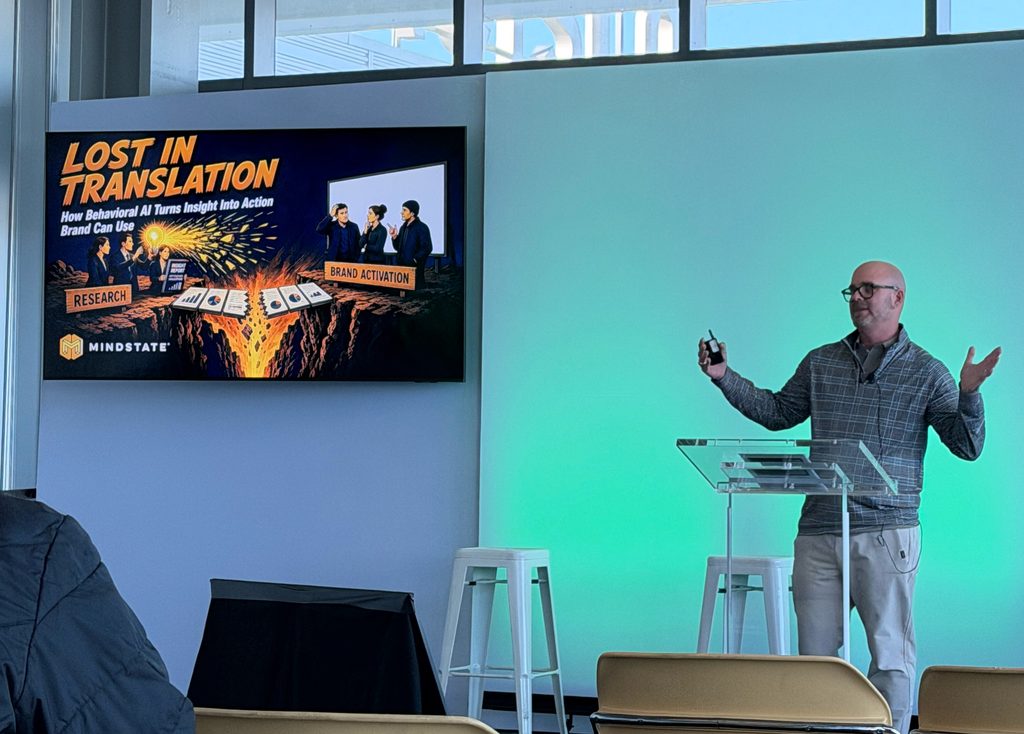
Between readout and brand strategy, insights get flattened, softened and swapped for whatever already fits the campaign. That translation is ours to own. Leach’s test: if the brand team can’t run the page without calling you, you’re not finished.
Train what AI can’t
The stakes are personal. Kristen Griffith of Clorox shared MRII data showing 47% of market researchers worry about losing their job to AI, up six points in a year. IBM data names critical thinking as the skill workers most often say AI is eroding. If you’re choosing where to invest next year, put storytelling, synthesis and influence ahead of learning another platform.
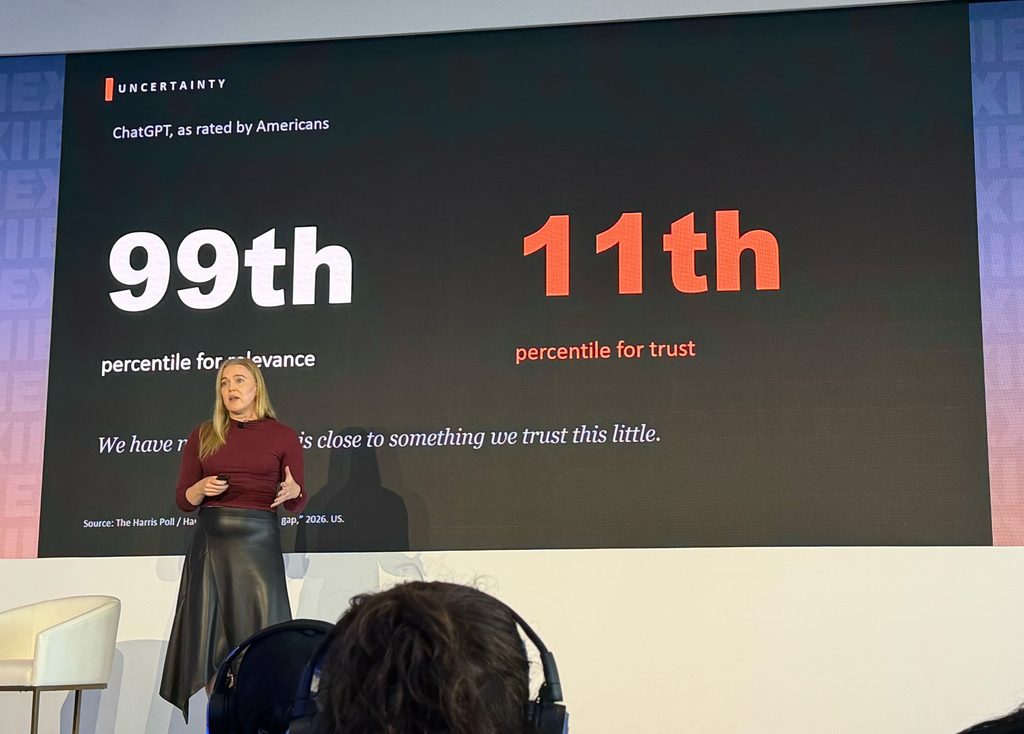
Everybody uses AI. Nobody trusts it.
That was the title of Griffith’s session, and it’s the best six-word summary of the consumer I’ve heard this year. ChatGPT ranks in the 99th percentile for relevance and the 11th for trust. The microwave was scary until it was in every kitchen, but familiarity isn’t breeding comfort this time. Behavior is running ahead of belief.
And it’s landing on a consumer who is already stretched. US consumer sentiment hit 44.8 in May, which Griffith’s slide called the lowest since 1952. Meanwhile,78% of shoppers assume brands will try to pay their way into AI-generated recommendations, according to The Harris Poll’s Algorithmic Aisle study.
What this means for research
- When trust is this low, the say-do gap widens, so observed behavior deserves more weight than stated intent.
- Brand halo is weaker than we assume. Harris data shows 81% of consumers care more about how a product works than which brand it is. Test whether an idea has pull on its own, before the logo does the work.
Humans are still the ground truth
Nobody at IIEX argued that the humans can be skipped. Even the Google and Listen Labs session admitted synthetic data isn’t there yet for tracking. Hearing from real people builds an empathy that a model can’t.
After the 2024 toxic tampon headlines, The Flex Co.’s instinct was to cast tampons as the villain. Consumers didn’t respond. As Sydney Williams of Flex and Alexis White of Knit shared, the real barrier was confidence. People didn’t trust themselves to use a menstrual disc, and no product claim fixes that. The insight was what it feels like to be a beginner all over again.
No dashboard hands you that. Paula Rosecky and Joshua Corona of SocioLens summed up the method in one slide I’d hang in any insights team’s office:
“Watch the what. Ask the why. Test the change.”
The 100-slide readout is dying. Lead with the bite.
Liz Riley Raukohl, who built OLLY’s insights function, couldn’t get 60 minutes on the calendar for a readout, no matter how good the work was. So she stopped asking. She started sharing bites, short findings dropped where her stakeholders already were, and then the invitations came. People invite you into the room for your knowledge, not your data.
Her advice, with Betsy Shaak of Voxpopme, is easy to act on:
- Drop a quick qual video into the pre-read for a meeting you’re running in two weeks.
- Ask your top stakeholder what they’re deciding this month, and build your next readout around it.
- Move your methodology slide to the appendix and lead with the answer.
Our stakeholders scroll the same feeds our consumers do, and as Google and Listen Labs noted, 30 seconds of a consumer in their own words can turn a decision. Insights should arrive that way: a clip, a one-line answer, an audio brief for the commute. The deck doesn’t disappear. It becomes the appendix.
What we’re taking home
Lead with the answer. Methodology goes in the appendix.
- Build every readout around a decision. Ask your top stakeholder what they’re deciding this month and work backward.
- Earn the meeting with bites. Send the clip, the one-line finding or the audio summary first. Let the meeting be the follow-up.
- Write recommendations the brand team can run with. If they have to call you to decode it, it isn’t done.
- Decide where AI belongs on purpose. Let it draft where mistakes surface early. Interpret first where they hide.
- Weight what people do over what they say, especially where trust is falling.
At Orchard, our work sits on the “watch the what” side of that equation: we launch ideas as real ads in social feeds and measure what people actually stop for, click on and choose. If people live in feeds, our deliverables should too, and we’re going to find out what that looks like.
AI will keep getting better at the analysis. The insights professionals who win will be the ones who can make a room feel something and do something about it. The insight was never the deck.