Testing in the wild reveals the next fall favorite
There’s something about that first Pumpkin Spice Latte of the season.
Maybe it’s the cinnamon and nutmeg, the familiar sweetness, or the way a warm cup feels especially good when there’s a chill in the air. Maybe it’s the memories that come with it: a trip to the pumpkin patch, Thanksgiving dinner, or the first time you tried one years ago.
Since Starbucks introduced it in 2003, it’s grown from a seasonal coffee experiment into a cultural signal that fall has arrived. And more than two decades later, it still owns the season.
Is there room for a new fall favorite? What gives a seasonal flavor that kind of staying power? And how can brands tell when a flavor has the potential to connect with coffee drinkers beyond the initial buzz?
We ran a test to find out.
How we tested it
We met coffee drinkers where they already are: on their phones, mid-scroll, probably with a coffee already in hand. Real feeds, real people, and real reactions to every one of our coffee experiments.
We built 21 fall flavors across five territories: Bright & Fruity, Rich & Decadent, Warm Spice, Nutty & Roasted, and Tea Lattes. The lineup ran from Apple Cider Donut to Black Sesame Mooncake, with Pumpkin Spice as the control.
Every flavor got its own sensory description, and we showed it two ways:
The first message was a brand’s pitch: a polished post from Moonlo Coffee Co., our mock-branded coffee shop.
The second was a peer’s recommendation: a tweet-style post written the way a friend shares a new find (“didn’t wanna gatekeep this one ☕”).
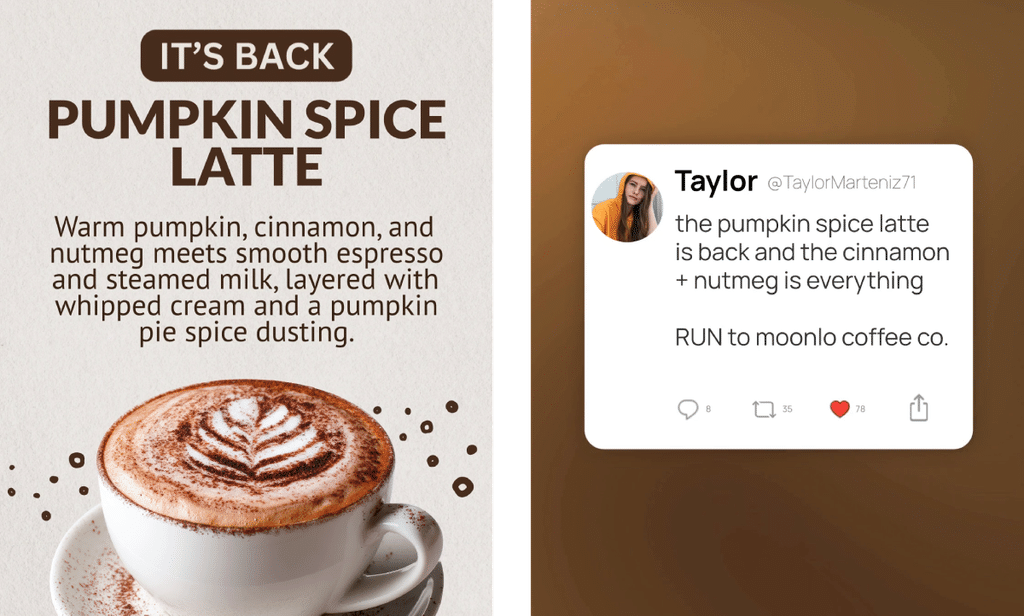
We placed all 42 ads in the Instagram feeds of US Starbucks customers, ages 18 to 64. Nobody knew they were part of a test, so they scrolled the way they always do: pausing on what caught their eye, reacting to what they loved, and clicking “learn more” on what they wanted to try.
Across 17.2K impressions, we tracked every one of those moments, using click-through rate as a real-world signal of purchase intent, and ranked each concept with the Orchard Index.
Here’s what we found
Honestly, even we were surprised by the results.
Pumpkin Spice lost its crown. Not just one or two, but nine of the twenty new flavors outscored it.
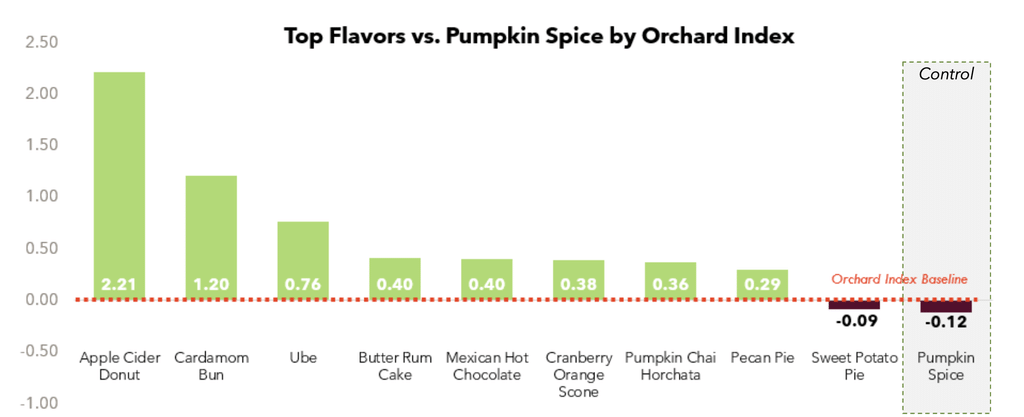
Apple Cider Donut took the top spot. Its mock-branded ad held attention better than any other ad in the test, with a 31% VVR and 2.7% CTR. 31% VVR is huge. In a crowded feed where most posts get scrolled past, nearly one in three people stopped to watch. Cardamom Bun came in second, and Ube took third. Ube also earned the highest CTR in the test (3.6%), with Cardamom Bun and Mexican Hot Chocolate close behind (3.1% each).
Those clicks matter. When someone taps “learn more” on a flavor they’ve never tried, it’s a strong signal they’re interested in buying it.
Not every flavor made the cut, though. Everyday bakery favorites like Banana Bread and Cinnamon Roll landed near the bottom, and most of the tea lattes, from Matcha to Chestnut Hojicha, trailed Pumpkin Spice. The flavors that won struck a balance: exciting enough to try now, but familiar enough to imagine what that first sip tastes like.
Comfort meets curiosity
Looking at the top three, each one seems to draw people in a little differently.
Apple Cider Donut taps straight into nostalgia. Maybe it brings you back to a family farm, a paper bag of warm donuts, or an afternoon wandering an apple orchard. For someone else, it might call to mind a local bakery or a tradition they look forward to every year. Those memories are personal, but the feeling is shared. It may be new to the menu, but it tastes like a memory we already have. That matters, because a single taste can bring back moments we haven’t thought about in years. And as we’ve written before, nostalgia earns trust fast, but the product still has to live up to it. Apple Cider Donut does both, pairing the warmth of a fall tradition with enough novelty to feel worth trying.
Cardamom Bun feels cozy while inviting curiosity. Vanilla bean and brown sugar make it cozy and approachable, while cardamom, a warm spice many people know but rarely find in their coffee, adds a little intrigue.
Ube is the wild card. A purple yam in a latte is hard to scroll past, but its flavor is softer than its color suggests: sweet, earthy and nutty, with a hint of vanilla. Novelty can still earn the click without earning a second visit, and that’s the real test for a flavor like Ube.
Look past the flavors themselves, and the winners have something in common. Their descriptions did a lot of the work: vanilla foam, brown sugar, cinnamon sugar and toasted coconut gave people something to taste in their heads. Those familiar notes grounded each flavor, while the new ingredient made it exciting. The pairing of comfort and discovery is what gives a seasonal flavor staying power.
The feeling behind the flavor
Pumpkin spice’s popularity may have less to do with how it tastes and more to do with the season it signals.
At Starbucks, the Peppermint Mocha and Eggnog Latte actually came before Pumpkin Spice. So why does it feel like fall has its own signature flavor?
That may be because fall is a season of transition. The days grow shorter, the air turns crisp, and a warm drink becomes a small comfort as we ease into the colder, darker months ahead. Fall is also full of rituals: picking pumpkins, carving jack-o’-lanterns, gathering around the table for Thanksgiving. Nostalgia is woven into the season itself. Pumpkin spice became the taste of those moments, and once a flavor becomes part of a memory, it’s hard to separate the two. Apple Cider Donut taps into that same well of memories.
A seasonal flavor can bring back a familiar memory or evoke the longing for an experience or place we have yet to know firsthand. Japan’s cherry blossoms in spring have inspired generations of cultural traditions. For someone who has never seen the blossoms in person, a cherry blossom drink can still carry a sense of something beautiful, fleeting, and far away. Red Bull already bet on that feeling with its Spring Edition Cherry Sakura.
What this means for brands
Pumpkin Spice still beat more than half the new flavors, so it’s far from finished.
But it’s no longer the only fall flavor people want. Its success may never be copied outright, but its formula can be followed: familiar comfort and connection to the season, with something worth discovering.
And that formula doesn’t have to stop at fall. In the US, spring and summer still don’t have a flavor that defines them the way pumpkin spice defines fall. That’s a wide-open opportunity, and one that’s worth testing.
What this test can’t show yet is what happens after the first click, and whether a new flavor can become something people come back to year after year. That answer won’t come from asking if someone likes pumpkin spice. It comes from the feed, from the people deciding what to stop for, what to click and what to try again. The same is true for any brand launching a limited edition, a holiday product or an entirely new line.
Orchard tests ideas in the wild, with real feeds and real behavior, so brands know how consumers will respond before an idea is on the menu, the shelf or the shopping cart.
Somewhere in the scroll is your next seasonal hit. Are you ready to find it?