Each month, we choose a potential say-do gap to put to the test. Consumers may think they know themselves and their habits, but how well do they, really? We know survey data is flawed, and in previous experiments, we’ve seen where consumers’ best intentions break down in the real world. This month, our in-the-wild experiment is tackling the notion that most consumers would rather DIY their Halloween decor than buy it new. Do you think it holds true? Let’s find out.
Spooky season has a split personality
Search “Halloween decor” on Instagram and you’ll get two kinds of content.
Half of it tells you to run to a big box store before the shelves empty. The other half shows someone turning a dollar store skull and a thrift store find into the centerpiece of the season in under 30 seconds.
Halloween is a huge market. According to the National Retail Federation, consumer spending on Halloween is expected to reach $13.5 billion in 2026. And with dopamine decorating in full swing, people want a setup that feels like theirs: a chic, silk-drenched vampire dinner party (brave) or a candlelit hallway lined with floating witch hats for the coven’s annual Hocus Pocus night.
You’d expect DIY to be having a moment, but the survey data says otherwise.
The say
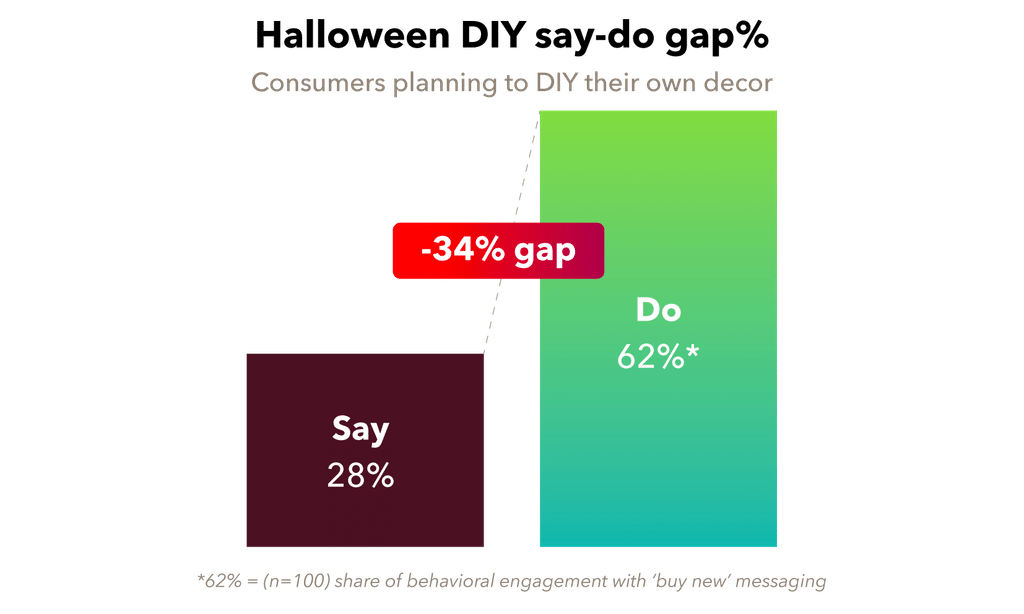
According to Numerator, only 28% of consumers plan to DIY their Halloween decorations.
We weren’t convinced. Our hypothesis going in: DIY is a huge opportunity for retail brands. In this case, we think the survey undersells it. A survey captures hypothetical plans consumers might carry out. Social media feeds capture their real behavior. Would that 28% hold up once consumers saw a DIY idea instead of being asked about one? We didn’t think so. So, we tested it.
The do
We built two ads and placed them in the social feeds of Gen Z and Millennial consumers. Both showed a product-agnostic image of a pearl-studded skull that could pass as a DIY project or something store bought.
Both ads shared the headline: “the skull everyone’s asking about”
Message A leaned into buying new: “i got mine at Hexd Home!”
Message B leaned into DIY: “i made mine with a DIY kit!”
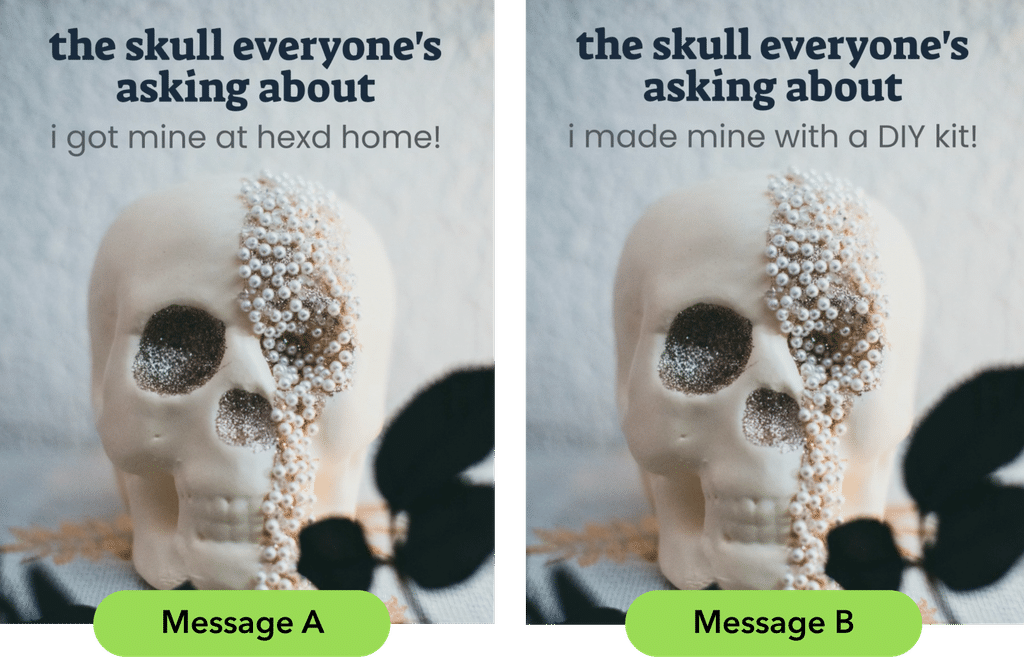
With the image and headline held constant, the message carried the only variable. Because the ad presented the skull as a product, we framed DIY as a kit, so both options gave consumers something to buy. We measured click-through rate as a signal for purchase intent.
Here’s what we found
Consumers are more interested in making their own than they let on in the survey.
Only 28% said they plan to DIY. But, in feeds, the DIY message pulled well past that number. That’s a -34% say-do gap. Consumers under-reported what they thought they’d do.
What this gap tells us
This is the second month in a row where the gap pointed toward opportunity. Like our Gen X test, it surfaced a demand that a brand relying on survey data would have overlooked.
So why did consumers under-claim? Here’s three possible reasons:
The survey makes them evaluate the work. Social feeds make them evaluate the result.
A survey question about DIY can trigger thoughts like That sounds like a lot of work or I don’t have time for that. An ad can skip straight to the finished product: Wait, I could make that. The survey asks them to picture the work while the ad shows them the result; the result is what sells them.
Making something makes it mean more.
Buying new decor means choosing from what’s already available. DIY gives consumers a chance to make something that reflects their own style, space, or vision. And when they put their own effort into the finished product, the result can carry a sense of personal value that a store-bought item doesn’t. Psychologists call it the IKEA effect.
Real behavior is messy and impulsive.
Most purchase decisions happen fast, emotionally, and without much of a plan. It’s the 0.3-second reality of how people actually buy. One of our team members had no intention of building the Spooky Island disco skull from the Y2K Scooby-Doo movie that went viral this year. Then, a 30-second tutorial popped up, and they were deep in a supply list before logic or reasoning ever entered the chat.
What this means for brands
Our Seed test showed that DIY kits are a product type that consumers are interested in. A brand that relied on surveyed data would have missed that signal.
It also opens a new set of questions. If this skull kit went to market, would consumers buy it? Or would they treat the ad as inspiration and source their own materials? To find out, we could test the kit against a socially native post listing every material needed. From there, we could test what problem a kit solves for consumers: time, money, convenience, or something else.
The product itself is worth a closer look too. Would a skull kit draw more purchase interest than a bubbling cauldron? And beyond Halloween, where else could a DIY kit fit? Holiday wreaths, wedding centerpieces, dorm room decor?
Those are the questions testing in the wild is built to answer. Orchard puts real ideas in front of real consumers, so brands can act on what people do, not just what they say.
Think your customers would rather make it than buy it? Let’s test it.